Tod@s invitad@s al curso/seminario *Principles of Psychology de J. R. Kantor a cien años*.
🙋♀️ 🧠 🙋
Participarán colegas de Sociedad Mexicana de Análisis de la Conducta, de la Universidad de Sonora, de la Universidad Autónoma de Ciudad Juárez y de la Universidad Autónoma de Baja California.
Tod@s invitad@s el lunes, 4 de diciembre, a las 13 hs (Buenos Aires) a este webinar gratuito sobre *¿Qué es y cómo se usa la plataforma Open Science Framework?*.
ISCP 2023 last week in Aguascalientes, Mexico, was a stounding success—thank you Aaron Blaisdell, Felipe Cabrera, and Hugo Reyes for organizing such a wonderful event! And thanks to SINCA for hosting us.
In the context of ISCP 2023, we held our business meeting, and a new Board of Directors was elected. We had a substantial number of nominees—I want to thank all of them for their interest in the international promotion of comparative psychology. The elected Board is truly international, with members located in six countries from all continents except Asia.
President: Leonardo Ortega (Fundación Universitaria Konrad Lorenz, Colombia)
Secretary: Jonathan Buriticá (Universidad de Guadalajara, Mexico)
Treasurer: Federico Sanabria (Arizona State University, USA)
Members-at-Large:
Aaron Blaisdell (University of California Los Angeles, USA)
Sarah Cowie (University of Auckland, New Zealand)
Brissa Gutierrez (Arizona State University, USA)
Gabriela Lopez-Tolsa (Universidad Nacional de Educación a Distancia, Spain)
Eduardo Reynoso (APOPO, Tanzania)
Two non-elected Board members that continue working with us:
Journal Editor: Charles Abramson (University of Oklahoma, USA)
Web Site Manager (interim): John Solórzano-Restrepo (Texas Christian University, ASU)
There is plenty of work ahead of the Board, including a revision of our bylaws, strengthening our finances, and planning for ISCP 2025.
Stay tuned for updates!
Fed
Federico Sanabria
Associate Professor – On Sabbatical Leave Department of Psychology Arizona State University PO Box 871104 Tempe AZ, 85287-1104 https://bit.ly/3tAsofC
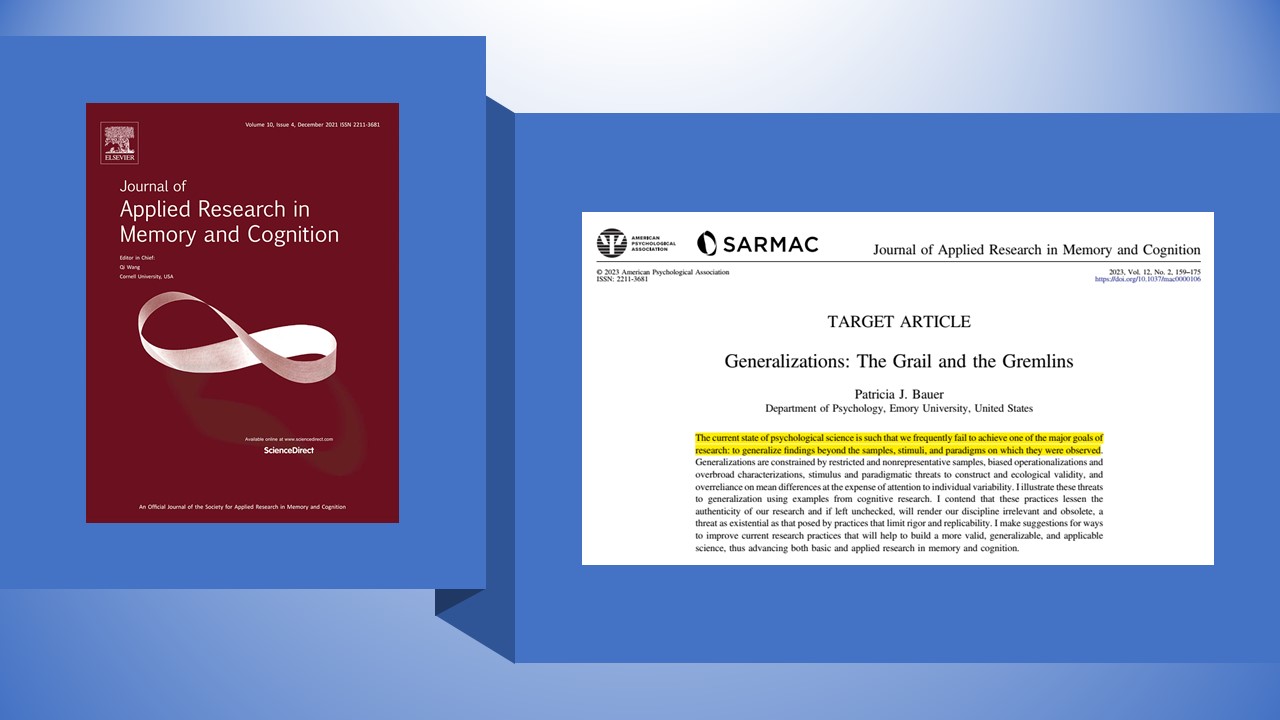
Using examples from cognitive research, this article examined threats to generalization, providing suggestions for ways to improve current research practices that will help to build a more valid, generalizable, and applicable science.
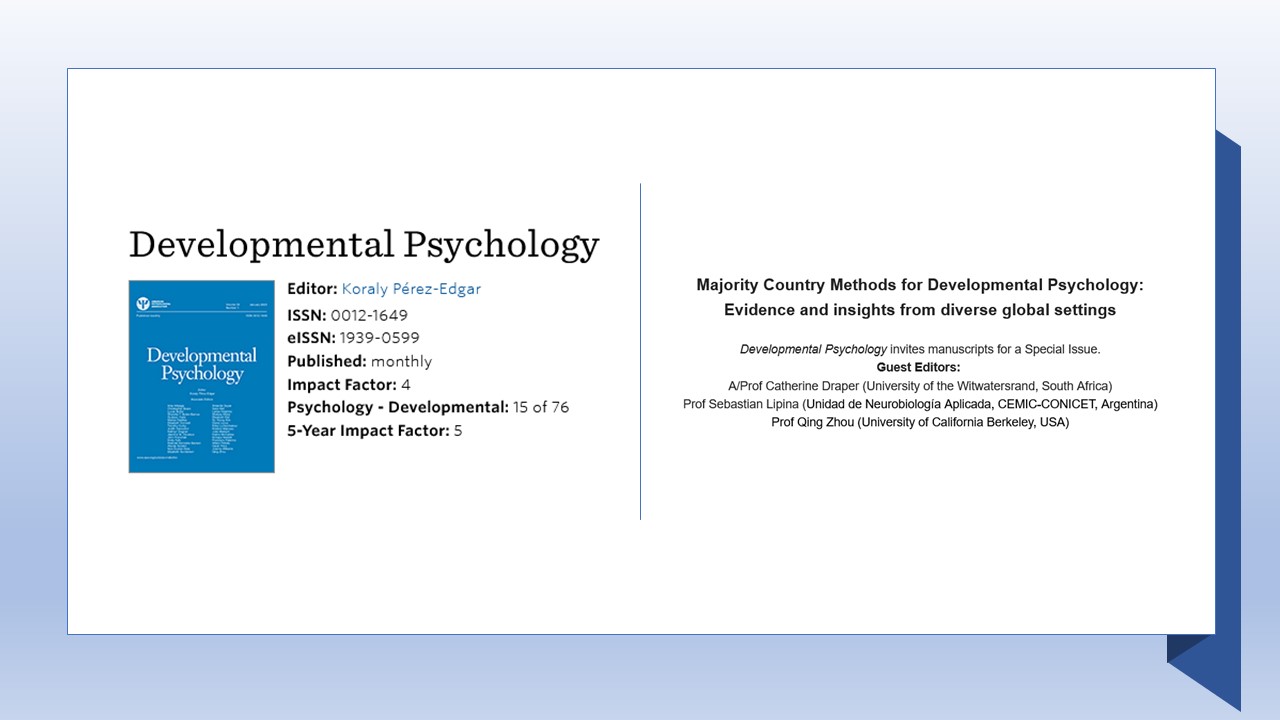
Les compartimos información sobre la convocatoria realizada por la revista DEVELOPMENTAL PSYCHOLOGY para su SPECIAL ISSUE «Majority Country Methods for Developmental Psychology:Evidence and insights from diverse global settings”.
Publication bias in child development has repeatedly been highlighted, with early criticisms focusing on the narrow focus of psychology on American (Arnett, 2008) and ‘WEIRD’ (Western, Educated, Industrial, Rich, and Democratic) populations, an acronym introduced to draw attention to the lack of representation in our understanding of human psychology and behavior (Henrich et al., 2010b, 2010a). Increasingly, the terms ‘Majority’ and ‘Minority World’ (Alam, 2019) are used instead of terms such as WEIRD, Global South, developing or low- and middle-income countries in order to not reinforce false hierarchies and notions of superiority (Khan et al., 2022). Rather, Majority World refers collectively to the countries that make up the majority of the world’s population, and serves as a reminder that Western Countries constitute the minority (Khan et al., 2022).
Similar arguments regarding the lack of diversity in child development research have been made more recently (Moriguchi, 2022; Nielsen et al., 2017), including for specific fields such as cognitive development research (Alves et al., 2022; Miller‐Cotto et al., 2022; Rowley & Camacho, 2015), caregiving (Benito‐Gomez et al., 2020; Raval & Walker, 2019), physical punishment and child development (Gershoff & Grogan-Kaylor, 2016; Heilmann et al., 2021), and early childhood development interventions (Draper et al., 2023; Ferreira et al., 2020). Furthermore, reviews published in 2023 have noted biases in infant development (Singh et al., 2023), and linguistic (Bylund et al., 2023) research. Beyond the bias in participants and authors, these skewed representations extend to editorial boards in the developmental and broader psychological sciences (Moriguchi, 2022; Thalmayer et al., 2021).
In a recent commentary on publication bias (Draper et al., 2022), the importance of contextualizing research was emphasized, particularly for methodological research in child development. While there are encouraging steps being taken to democratize measurement, methodological challenges of conducting research in Majority World countries include the reliance on English as the language of assessment (or at least the original language of tool development), difficulties with translation and validation, limitations of contextual validity, and the assumption that tools developed for specific settings do not have broader applicability. Overall, the methodological bar is higher for the publication of empirical research in Majority World countries, with different standards being applied to small scale, localized studies in Minority World countries. This bias “perpetuates the centering of Minority country notions of what is ‘normal’ in child development” (Draper et al., 2022).
For this special issue on ‘Majority Country Methods for Developmental Psychology’, we encourage the following types of submissions on topics relating to developmental psychology research in Majority World countries:
Empirical articles highlighting unique or novel quantitative and qualitative methods.
Methodological articles, e.g., tool development, adaption, validation, best practices, or cross-contextual comparisons (e.g., exploring universality and specificity); with an emphasis on practical guidance, optimization for Majority World countries, or applicability across global settings.
Commentary and theoretical articles, focusing on methodological perspectives, e.g., innovations in measurement, large scale evaluations or population surveys in challenging or remote settings.
Systematic, mapping, and narrative reviews (applying rigorous review methods) on methodological perspectives.
Protocol papers, with an emphasis on methods / methodological approaches that are reflective of contextual realities in Majority World countries.
Qualitative methods being applied to measurement work, e.g., informing new measures, understanding constructs, engaging stakeholders in identifying what is important or useful to measure.
New or adapted applications of technologies to understand development, e.g., portable and/or lower cost neuroimaging techniques.
Use of technological or biological methods (e.g., eye-tracking, EEG, fNIRS, cortisol analysis) in Majority World countries, with a focus on practical advice for use in other similar settings.
Evidence-based proposals to broaden representation of Majority World countries and address the role of reviewer and editor bias in perpetuating a Western-centred narrative in developmental psychology.
Best practices in maintaining equity and justice in collaborations between Majority and Minority World countries.
To align with Developmental Psychology’s commitment to diversity, equity, and inclusion of the journal, papers should have meaningful local authorship representation. That is, papers submitted by researchers from Minority World countries should include authors from the Majority World settings where the research was conducted, as first, second or senior author.
Furthermore, for empirical papers, we encourage submissions comprising samples that vary in terms of parent gender; race/ethnicity; socioeconomic background; country of origin; child/familial risk arising from health or social vulnerabilities; and other factors.
In addition, we encourage submissions from authors who are historically underrepresented in psychology and related disciplines. Contributors are also highly encouraged to review and reference extant literature from diverse researchers and institutions.
Authors who plan to submit a manuscript for the special issue are asked to submit a letter of intent by October 1, 2023, that includes:
Tentative title;
Contact information and corresponding author;
Names and affiliations of anticipated authors;
Brief description of the study (500 words or less; structured as Background, Method/Sample, and Proposed Analyses or Results for empirical papers); and
A brief explanation (2 sentences) of the perceived fit between the submission and the themes described in this call; and
A brief description of the status of the project to ensure fit with the special issue timeline (i.e., data collection underway; data are already collected and in-hand; and analysis underway, for empirical papers) in 200 words or less.
The guest editors will review letters of intent for fit with the section and work to provide the broadest representation of high-quality papers. Letters of intent should be sent as Word documents to Catherine Draper (catherine.draper@wits.ac.za). In the accompanying email, please include in the subject line ‘Special Issue on Majority Country Methods’.
Following a review of received letters, potential contributors will be contacted by December 4, 2023, to submit full manuscripts. Invited manuscripts will be due by April 8, 2024, via Developmental Psychology’s submission site (https://www.editorialmanager.com/dvl/) and will be subjected to full peer review.
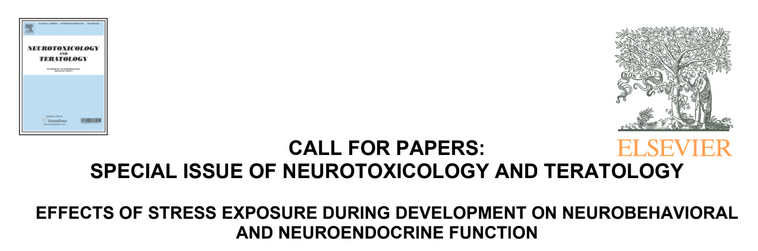
Les compartimos información sobre la convocatoria realizada por la revista NEUROTOXICOLOGY AND TERATOLOGY para su SPECIAL ISSUE «EFFECTS OF STRESS EXPOSURE DURING DEVELOPMENT ON NEUROBEHAVIORAL AND NEUROENDOCRINE FUNCTION”.
Stress, which can be defined as an actual or perceived threat to homeostasis, is a ubiquitous factor in modern societies. Stress exposure can adversely impact subsequent neurobehavioral and neuroendocrine functioning, especially when exposure occurs when the brain is developing (i.e., from the fetal period through adolescence). Such negative effects may result from stress alone as the primary developmental insult or from interactions of stress with other kinds of insults such as drugs or environmental toxicants. Importantly, the mechanisms underlying stress-mediated developmental perturbations are not yet fully understood. For example, increased glucocorticoid release is widely thought to mediate at least some of the adverse effects of stressful experiences, especially when the stress is chronic. However, stress gives rise to numerous other responses at the neurophysiological, cardiovascular, endocrine, immune, and epigenetic levels, and in many cases, the role of these responses has been understudied. Although we usually think about those stressors that are unique to a particular individual, recent events remind us that some stressors such as natural disasters, wars, or pandemics can induce both physical and psychological stress that can impact millions of people around the world, including infants, children, adolescents, and pregnant women. Given the timeliness of this topic, Neurotoxicology and Teratology is organizing a Special Issue on the theme of “Effects of Stress Exposure during Development on Neurobehavioral and Neuroendocrine Function.” This Special Issue, which will be co-edited by Drs. Jerrold Meyer, Gregg Stanwood, and Sonya Sobrian, is aimed at advancing our understanding of how stressful events perturb developmental trajectories, including characterization of such perturbations, as well as exploratory studies into their underlying mechanisms.
Submissions may include:
Primary data driven reports
Critical review papers
Prospective/retrospective human studies
Empirical studies using models of acute or chronic stress in laboratory animals
The following are examples of relevant topics for this Special Issue:
Delineating windows of vulnerability to stress during prenatal and early postnatal development
Influences of stress on subsequent child emotional and/or cognitive development
Long-lasting neurobehavioral effects of adverse childhood experiences (ACEs)
Models of developmental stress exposure in laboratory animals: Relevance for human clinical studies
Sex differences in the effects of developmental stress exposure
Transgenerational effects of stress exposure (human or animal studies)
Studies of developmental stress exposure involving natural events such as war, environmental disasters, or pandemics
Biological (e.g., neurobiological, neuroendocrine, neuroimmune, or epigenetic) mechanisms that mediate the long-lasting effects of developmental stress exposure
Interactions among drug and environmental chemical exposures and developmental stress
Pertinent gene-environmental stress interactions
All submissions to this Special Issue will be fully peer-reviewed, and because Neurotoxicology and Teratology is abstracted and indexed in BIOSIS, Current Contents/Life Sciences, EMBASE, EMBiology, ETOH, Elsevier BIOBASE, MEDLINE®, Science Citation Index, and Scopus, its contents will be available through typical search engines of the medical literature (e.g., PubMed). The Special Issue will also be circulated to all subscribers of the journal and be accessible via ScienceDirect. This Special Issue will be in the form of a Virtual Special Issue (VSI), which is an approach to publishing special Issues that allows us to address one of the most common complaints by authors – slow publication speed. With a VSI, accepted manuscripts are published in the first available regular issue, and corresponding authors will receive 50 days free access to the final published version of their manuscript. Thus, authors do not need to wait until all the Special Issue manuscripts are accepted to have their manuscript published. Simultaneously, articles will appear in a VSI section on the Neurotoxicology and Teratology website and on ScienceDirect. To be considered for inclusion in this Special Issue, please submit your manuscript to Neurotoxicology and Teratology by January 31, 2024, via the electronic submission system (https://www.editorialmanager.com/ntt/default.aspx). Manuscripts should be assigned to the category “VSI: Dev Stress” at the beginning of the submission process, and a cover letter to the Editor should also specify that the submission is targeted for this issue. We hope that you will consider this invitation seriously and submit your best work to this issue. Recent trends in scientific publication indicate that articles that appear in special issues receive a great deal of attention and we hope that you will take advantage of this opportunity. If you have any questions, feel free to contact one of the Co-Editors. We look forward to your contributions to this Special Issue.
Thank you.
Special Issue Co-Editors’ Contact Information Jerrold S. Meyer, Ph.D. University of Massachusetts Dept. of Psychological and Brain Sciences Email: jmeyer@umass.edu Gregg Stanwood, Ph.D. Florida State University School of Medicine Email: gregg.stanwood@med.fsu.edu Sonya K. Sobrian, Ph.D. Howard University School of Medicine Email: ssobrian@howard.edu Neurotoxicology and Teratology Contacts Jerrold S. Meyer, Ph.D., Special Issues Editor; Email: jmeyer@umass.edu
Les informamos que la fecha límite para el envío de resúmenes para la IV Reunión de Biología del Comportamiento del Cono Sur se extendió por última vez hasta el 10 de julio de 2023.
Esperamos sus trabajos para así poder conocer, compartir y discutir, entre todos los integrantes de nuestra comunidad científica, las investigaciones que están realizando.
¡No se la pierdan!
Se agradece la difusión.
Saludos,
— Comité Organizador de la IV Reunión de Biología del Comportamiento del Cono Sur
COMIENZA un CICLO de SEMINARIOS sobre MOTIVATED COGNITION!!!
💭
A new series of online talks on motivated cognition begins, in which the interaction between motivation and cognition will be discussed from different perspectives.
La Asociación Argentina de Ciencias del Comportamiento (AACC) convoca a la XIX Reunión Nacional y XVIII Encuentro Internacional de la Asociación Argentina de Ciencias del Comportamiento, que se realizará durante los días 23, 24 y 25 de Agosto del 2023, en la Ciudad Autónoma de Buenos Aires (Argentina), teniendo como sede la Facultad de Psicología y Psicopedagogía de la Universidad del Salvador, Marcelo T. de Alvear 1335, Buenos Aires.
La fecha de recepción de trabajos se ha extendido hasta el 30 de junio.
L@s esperamos!!!
Comisión Directiva de la AACC y Comisión Organizadora de la Reunión.
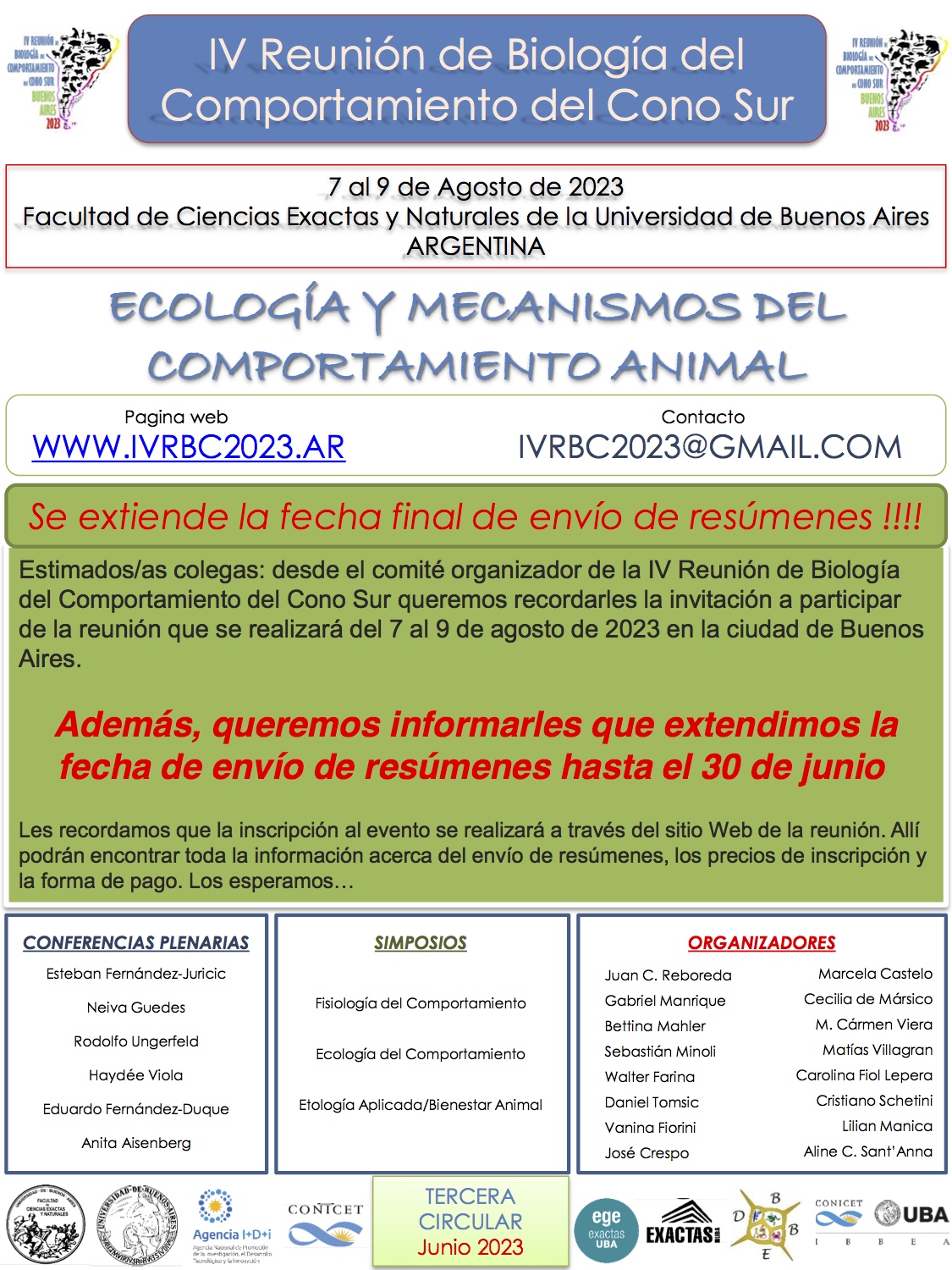
Les compartimos la Tercera Circular de la IV Reunión de Biología del Comportamiento del Cono Sur, que se realizará del 7 al 9 de agosto de 2023 en la Facultad de Ciencias Exactas y Naturales, Universidad de Buenos Aires (Argentina).
La fecha límite para el envío de resúmenes se ha extendido hasta el 30 de junio.
¡Esperamos poder contar con su presencia!
Se agradece la difusión.
Saludos cordiales,
Comité Organizador de la IV Reunión de Biología del Comportamiento del Cono Sur






 RedLACC