
Estimad@s.
Les compartimos información sobre la convocatoria realizada por la revista DEVELOPMENTAL PSYCHOLOGY para su SPECIAL ISSUE «Majority Country Methods for Developmental Psychology: Evidence and insights from diverse global settings”.
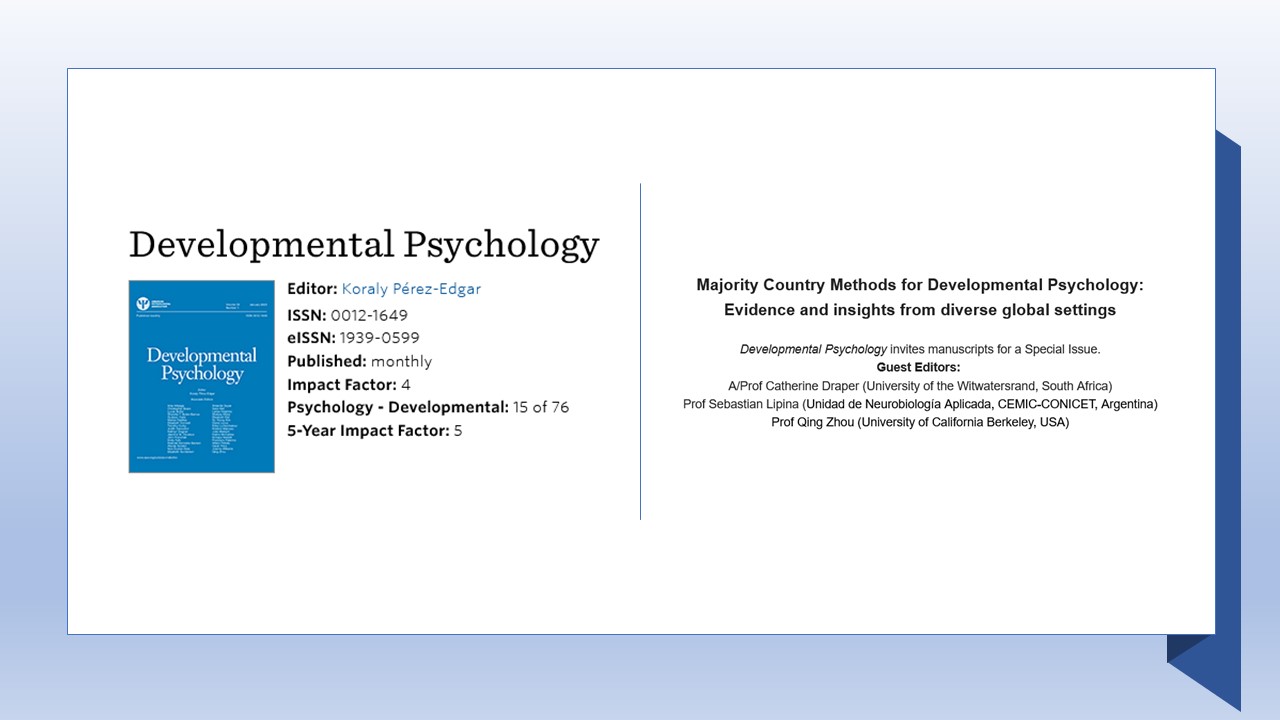
Publication bias in child development has repeatedly been highlighted, with early criticisms focusing on the narrow focus of psychology on American (Arnett, 2008) and ‘WEIRD’ (Western, Educated, Industrial, Rich, and Democratic) populations, an acronym introduced to draw attention to the lack of representation in our understanding of human psychology and behavior (Henrich et al., 2010b, 2010a). Increasingly, the terms ‘Majority’ and ‘Minority World’ (Alam, 2019) are used instead of terms such as WEIRD, Global South, developing or low- and middle-income countries in order to not reinforce false hierarchies and notions of superiority (Khan et al., 2022). Rather, Majority World refers collectively to the countries that make up the majority of the world’s population, and serves as a reminder that Western Countries constitute the minority (Khan et al., 2022).
Similar arguments regarding the lack of diversity in child development research have been made more recently (Moriguchi, 2022; Nielsen et al., 2017), including for specific fields such as cognitive development research (Alves et al., 2022; Miller‐Cotto et al., 2022; Rowley & Camacho, 2015), caregiving (Benito‐Gomez et al., 2020; Raval & Walker, 2019), physical punishment and child development (Gershoff & Grogan-Kaylor, 2016; Heilmann et al., 2021), and early childhood development interventions (Draper et al., 2023; Ferreira et al., 2020). Furthermore, reviews published in 2023 have noted biases in infant development (Singh et al., 2023), and linguistic (Bylund et al., 2023) research. Beyond the bias in participants and authors, these skewed representations extend to editorial boards in the developmental and broader psychological sciences (Moriguchi, 2022; Thalmayer et al., 2021).
In a recent commentary on publication bias (Draper et al., 2022), the importance of contextualizing research was emphasized, particularly for methodological research in child development. While there are encouraging steps being taken to democratize measurement, methodological challenges of conducting research in Majority World countries include the reliance on English as the language of assessment (or at least the original language of tool development), difficulties with translation and validation, limitations of contextual validity, and the assumption that tools developed for specific settings do not have broader applicability. Overall, the methodological bar is higher for the publication of empirical research in Majority World countries, with different standards being applied to small scale, localized studies in Minority World countries. This bias “perpetuates the centering of Minority country notions of what is ‘normal’ in child development” (Draper et al., 2022).
For this special issue on ‘Majority Country Methods for Developmental Psychology’, we encourage the following types of submissions on topics relating to developmental psychology research in Majority World countries:
- Empirical articles highlighting unique or novel quantitative and qualitative methods.
- Methodological articles, e.g., tool development, adaption, validation, best practices, or cross-contextual comparisons (e.g., exploring universality and specificity); with an emphasis on practical guidance, optimization for Majority World countries, or applicability across global settings.
- Commentary and theoretical articles, focusing on methodological perspectives, e.g., innovations in measurement, large scale evaluations or population surveys in challenging or remote settings.
- Systematic, mapping, and narrative reviews (applying rigorous review methods) on methodological perspectives.
- Protocol papers, with an emphasis on methods / methodological approaches that are reflective of contextual realities in Majority World countries.
- Qualitative methods being applied to measurement work, e.g., informing new measures, understanding constructs, engaging stakeholders in identifying what is important or useful to measure.
- New or adapted applications of technologies to understand development, e.g., portable and/or lower cost neuroimaging techniques.
- Use of technological or biological methods (e.g., eye-tracking, EEG, fNIRS, cortisol analysis) in Majority World countries, with a focus on practical advice for use in other similar settings.
- Implementation science, highlighting methodological insights.
- Evidence-based proposals to broaden representation of Majority World countries and address the role of reviewer and editor bias in perpetuating a Western-centred narrative in developmental psychology.
- Best practices in maintaining equity and justice in collaborations between Majority and Minority World countries.
To align with Developmental Psychology’s commitment to diversity, equity, and inclusion of the journal, papers should have meaningful local authorship representation. That is, papers submitted by researchers from Minority World countries should include authors from the Majority World settings where the research was conducted, as first, second or senior author.
Furthermore, for empirical papers, we encourage submissions comprising samples that vary in terms of parent gender; race/ethnicity; socioeconomic background; country of origin; child/familial risk arising from health or social vulnerabilities; and other factors.
In addition, we encourage submissions from authors who are historically underrepresented in psychology and related disciplines. Contributors are also highly encouraged to review and reference extant literature from diverse researchers and institutions.
Authors who plan to submit a manuscript for the special issue are asked to submit a letter of intent by October 1, 2023, that includes:
- Tentative title;
- Contact information and corresponding author;
- Names and affiliations of anticipated authors;
- Brief description of the study (500 words or less; structured as Background, Method/Sample, and Proposed Analyses or Results for empirical papers); and
- A brief explanation (2 sentences) of the perceived fit between the submission and the themes described in this call; and
- A brief description of the status of the project to ensure fit with the special issue timeline (i.e., data collection underway; data are already collected and in-hand; and analysis underway, for empirical papers) in 200 words or less.
The guest editors will review letters of intent for fit with the section and work to provide the broadest representation of high-quality papers. Letters of intent should be sent as Word documents to Catherine Draper (catherine.draper@wits.ac.za). In the accompanying email, please include in the subject line ‘Special Issue on Majority Country Methods’.
Following a review of received letters, potential contributors will be contacted by December 4, 2023, to submit full manuscripts. Invited manuscripts will be due by April 8, 2024, via Developmental Psychology’s submission site (https://www.editorialmanager.com/dvl/) and will be subjected to full peer review.
Questions concerning the substance of submissions should be directed to Catherine Draper (catherine.draper@wits.ac.za), Sebastian Lipina (slipina@cemic.edu.ar), and Qing Zhou (qingzhou@berkeley.edu).
 RedLACC